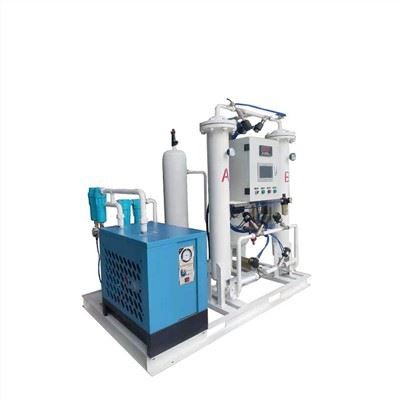
Due to the use of nitrogen sealing, the dye solution passing through the dyeing cylinder does not need to be fully filled, and only needs to reach a reasonable liquid level. When the yarn carries liquid on the sealing cylinder roller above the dye solution, it is equivalent to running in a full cylinder of dye solution. This greatly reduces the amount of dye solution used. After using nitrogen sealing for dyeing, our company has a total dye liquid volume of about 4000L, The total volume of the traditional pulp dyeing machine (10 passes) dyeing solution is about 11000L. The volume of dye solution in a nitrogen sealed pulp dyeing combined machine can only be 2/5 of the volume of traditional dye solution, and it can effectively ensure liquid level balance in practical operation. The dye solution rarely rises or falls before and after dyeing, and due to its small volume, color transfer is also more convenient and fast, reducing the need for a large number of storage barrels for dye solution storage and greatly reducing the discharge and treatment of waste dye solution, which is beneficial for environmental protection and energy conservation, as well as reducing waste. 1. Pressure Swing Adsorption (PSA) is a nitrogen equipment designed and manufactured using clean compressed air as raw material, using physical methods and pressure swing adsorption technology. The nitrogen generator uses high-quality imported carbon molecular sieve (CMS) as the adsorbent and adopts the principle of pressure swing adsorption at room temperature to separate air and produce nitrogen of different purities. Usually, two adsorption towers are connected in parallel, and the imported PLC controls the automatic operation of the imported pneumatic valve, alternating with pressurized adsorption and decompression regeneration to complete nitrogen oxygen separation and obtain nitrogen of different purities as required. Carbon molecular sieves can simultaneously adsorb oxygen and nitrogen in the air, and their adsorption capacity also increases with the increase of pressure, and there is no significant difference in the equilibrium adsorption capacity of oxygen and nitrogen at the same pressure. Therefore, it is difficult to achieve effective separation of oxygen and nitrogen solely based on changes in pressure. If we further consider the adsorption rate, we can effectively distinguish the adsorption characteristics of oxygen and nitrogen. The diameter of oxygen molecules is smaller than that of nitrogen molecules, so the diffusion speed is hundreds of times faster than that of nitrogen. Therefore, the adsorption speed of oxygen on carbon molecular sieves is also very fast, reaching over 90% in about one minute; At this point, the adsorption capacity of nitrogen is only about 5%, and the oxygen and nitrogen contents in the air are 21% and 78%, respectively. Therefore, at this time, most of the adsorbed molecules are oxygen molecules, while the remaining nitrogen molecules are enriched at one end of the adsorber, forming a product nitrogen that enters the nitrogen process buffer tank.